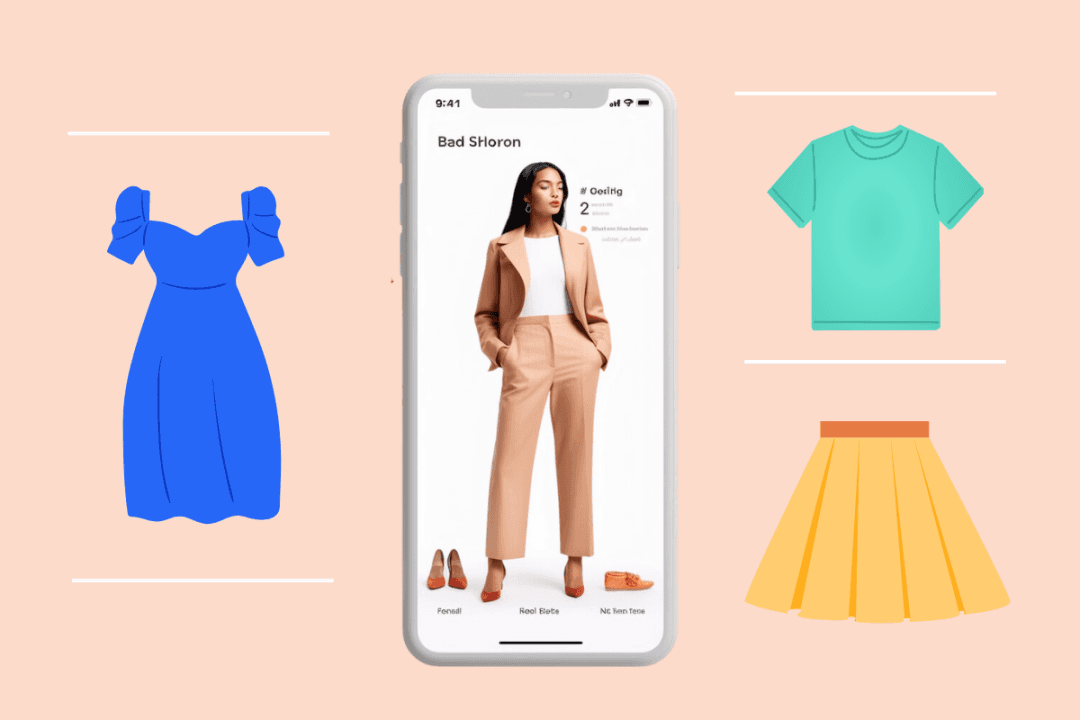
FitzStyles: The World's Coolest AI Stylist

Product Overview
FitzStyles is a fashion-technology platform offering an AI-powered personal styling experience across web, iOS, and Android. The product serves both end consumers (B2C) and fashion brand partners (B2B), bridging the gap between what people own and what they actually wear — while giving brands a direct, measurable link between AI-driven styling recommendations and confirmed sales.
Industry Fashion-Tech / AI Platform | Business Model B2C + B2B | Platforms Web · iOS · Android |
Business Challenge
Most People Own the Clothes. They Just Can't See the Outfit.
Decision fatigue is real. The average person owns enough clothing to construct hundreds of distinct looks — but without a trained eye, those combinations remain invisible.
Three compounding problems defined the challenge Prognos Labs was brought in to solve:
• Daily decision burden: Users struggle to create outfits from clothing they already own, leading to underutilisation of existing wardrobes.
• Product-grounding failure: Generic AI fashion tools hallucinate brands and products that do not exist, destroying user trust.
• Discovery gap: Fashion brands remain invisible at the precise moment a customer is most ready to buy, with no causal link from AI interaction to sale.
Traditional personal styling costs hundreds of dollars per session — making professional advice inaccessible to most consumers. Prognos Labs was engaged to close all three gaps simultaneously: reduce the daily decision burden, ground AI recommendations in real inventory, and build a commercially accountable discovery layer for brand partners.
Solution
One Platform. Three Surfaces. One Shared Intelligence Layer.
Prognos Labs conceived and built FitzStyles from scratch — a production-grade AI platform spanning three surfaces unified by a single data layer. The same preference store, embedding index, and attribution pipeline power all three.
Surface 1 — Fitz Chat: The AI Stylist
Fitz Chat is the primary interface — not a chatbot but an orchestrated system of specialist agents, a real-time embedding index, and a persistent memory layer working in concert. Every outfit recommended is retrieved from the live product catalog via vector similarity search and hard structured filters — never invented.
Intent — Deterministic Routing Intent classifier routes every message to the right specialist node — recommendation, preference update, outfit feedback, or general inquiry. No guessing. No misfires. | Memory — Preference That Persists One sentence — "I only wear neutrals" — writes to the preference store and filters every recommendation from that point forward. Users never repeat themselves. |
Retrieval — RAG-Grounded Recommendations Every outfit is retrieved, not generated. Vector similarity plus hard filters (gender, size, colour, price, occasion) means Fitz can only recommend items that actually exist in inventory. | Vision — Outfit Photo Feedback Upload a photo; get feedback personalised to stored preferences — not generic commentary. Vision only fires when an image is present, minimising inference cost. |
Speed — One-Turn Updates A mid-conversation preference change triggers an immediate re-recommendation in the same turn. Profile update and fresh outfit in one response. No second prompt required. | Ops — Full Observability LangSmith tracing wraps every node. Failed runs are debuggable post-hoc with full message history, routing decisions, and tool calls visible. |
Surface 2 — The Social Platform
A full social layer where users post outfits, follow creators, and discover looks from people with similar body types and style profiles. Every post is shoppable: Fitz's recommendation engine maps tagged items to live catalogue inventory, surfacing affiliate or brand-direct purchase links automatically.
• Shoppable outfit posts — users tag garments to live SKUs; discontinued links auto-resolve to catalogue alternatives.
• Creator profiles with follower counts, style affinity scores, and a verified badge system for brand-partnered creators.
• Saves and collections — named boards where saved items feed back into Fitz as implicit preference signals.
Surface 3 — The Ecommerce Storefront
A native storefront embedded directly in the app — not a redirect to a third-party retailer. Users browse, filter, add to cart, and check out without leaving the platform. Every product is drawn from the same catalogue that powers Fitz recommendations, keeping inventory and pricing always in sync.
• Personalised storefront.
• Native cart and checkout with full purchase flow within the app.
• Size-aware filtering: out-of-stock sizes suppressed entirely.
• Brand storefronts — each partner has a dedicated shop-in-shop managed from their B2B dashboard.
• AI-written product descriptions adapting tone based on the user's stored profile.
• Wishlist-to-recommendation loop — wish-listed items inform future Fitz recommendations.
Want to build Custom AI Software? Let's talk
Architectural Decisions
Every technology decision was governed by a single constraint: ship software that works in production for real users, not a proof of concept that impresses in a slide deck.
Multi-Agent over Monolithic Prompt
Prognos Labs designed a directed graph of specialist nodes rather than a single large prompt. An intent classifier running at temperature zero routes each message deterministically. Each specialist node is cheaper, faster, and independently testable. The result is a system that becomes more accurate and more cost-efficient the more it is used.
One Database, All Layers
The preference store, embedding index, vector search, auth, and file storage all run on a single Supabase Postgres instance with Row-Level Security. No secondary vector database. Row-Level Security isolates all user data at the database layer — simpler to operate and cheaper to scale.
Process of Delivery
From Zero to Production in 11 Weeks
FitzStyles did not exist before Prognos Labs. The team conceived the product architecture, designed the full system, wrote every line of code, and shipped a production-grade AI platform spanning web, iOS, and Android — in under three months.
AI Architecture — Agentic System Design Prognos Labs designed the multi-agent LangGraph architecture from scratch, decomposing what most agencies would ship as a single monolithic prompt into five specialist nodes, each cheaper, faster, and independently testable. | Full-Stack Engineering — End-to-End, One Codebase One codebase ships simultaneously to web, iOS App Store, and Google Play. Prognos Labs built the frontend, the Supabase backend, the embedding pipeline, and the mobile wrappers. |
B2B Architecture — Brand Revenue Layer Prognos Labs designed the closed-loop attribution system — events tracked from Fitz recommendation through to confirmed purchase. Fashion brands can see exactly which AI touchpoint closed which sale. | Data Infrastructure — One Database, All Layers The preference store, embedding index, vector search, auth, and file storage all run on a single Supabase Postgres instance with Row-Level Security. No secondary vector database. |
What Was Delivered
AI & Intelligence Layer
• Multi-agent orchestration with specialist nodes
• Advanced RAG pipeline
• Vision inference for outfit photo feedback
• Persistent preference memory— propagated as RAG filters on every turn
• Full observability — every agent step logged and post-hoc debuggable
Platform & Infrastructure
• Web application
• Native iOS and Android apps from the same codebase
• Supabase auth, Row-Level Security, storage, and Postgres
• 8 B2B brand dashboard pages: catalog, campaigns, analytics, messaging
• End-to-end purchase attribution pipeline (view → click → cart → purchase → refund)
• Production CI/CD deployment pipeline
Data Privacy & Security
• Row-Level Security on all Supabase Postgres tables ensures complete user data isolation at the database layer.
• Supabase Object Storage with scoped access policies for user-uploaded wardrobe images.
• Auth handled entirely via Supabase — no custom credential management.
• All preference and behavioural data are stored within the single Postgres instance, reducing third-party data exposure.
• LangSmith observability retains full trace history for audit and debugging without exposing user PII externally.
07 Success Metrics
The figures below reflect the platform's performance at launch across all three surfaces.
3.2×Conversion lift vs. pre-AI baseline | 68%Reduction in cost-per-recommendation | 11 wksBrief to cross-platform launch |
Metric | Value |
Session-to-purchase conversion lift vs. pre-AI baseline | 3.2× |
Reduction in cost-per-recommendation vs. human stylist | 68% |
Weeks from brief to full cross-platform launch | 11 |
Shop open-to-purchase conversion rate | 4.8% |
Share of purchases originating from Fitz Chat | 61% |
Share of purchases originating from the social feed | 29% |
Average saves per active user per month | 14 |
Social posts generated at launch | 10,000+ |
SKUs in live catalog at launch | 25,000+ |
Brands with active storefronts | 40+ |
Implementation Journey
How we bring your vision to life
Process & Cost Diagnostics
AI System Design
Deployment & Change Management
Evaluation & Enhancement
Process & Cost Diagnostics
AI System Design
Deployment & Change Management
Evaluation & Enhancement
Integration & Compliance
CI-compliant checkout via secure tokenization
Automated GDPR/CCPA compliance for data erasure
Real-time B2B sync preventing out-of-stock errors
Scale of Application
3.2x
Conversion lift vs. pre-AI baseline
68%
Reduction in cost-per-recommendation
11 weeks
Brief to cross-platform launchin cost-per-recommendation